
29 September - 1 October, 2020
| Berlin, Germany
Agenda Day 1
8:30 am - 9:00 am
Registration and welcome coffee
9:00 am - 9:10 am
Opening remarks by conference chairman
Bo Johansson -
Director Strategy & Special Projects,
Volvo Group, Sweden


9:10 am - 9:50 am
European Battery Alliance – what future for EV/HEV?
Paul Hodgson -
Head of the Unit “Energy Storage” DG Joint Research Center (JRC),
European Commission
European Battery Alliance – what future for EV/HEV?
• Why is a cooperation so important?
• Sustainable Mobility for Europe: safe, connected and clean
• How to integrate all players, from materials, battery pack manufacturing and OEMs to recycling
• Future roadmap

Paul Hodgson
Head of the Unit “Energy Storage” DG Joint Research Center (JRC)European Commission

9:50 am - 10:20 am
Match and Meet
10:20 am - 11:00 am
Refreshment break and networking
11:00 am - 11:40 am
Effect of electromagnetic interference on battery systems
Karthik Ganesh -
Battery Engineer,
Mercedes-Benz Research and Development, India
Effect of electromagnetic interference on battery systems
This presentation will discuss the following elements:
• Electromagnetic footprint of power electronic components in an electric vehicle
• Understand the effect of electromagnetic noise on battery systems
• Criticality of implications on the normal functioning of battery management system
• Ideas on how to design and protect battery systemS


11:40 am - 12:20 pm
BMS in commercial electric vehicles: challenges and opportunities
Faisal Altaf -
Principal Research Engineer & Project Manager AE and Research—ESS Control & SW,
Volvo Group Trucks Technology
• From vehicle to battery function level requirements
• Needs of advanced BMS functionality in modern EVs
• What are major challenges compared to passenger cars?
• Multi-level functional requirements
• Multi-battery system and control architecture
• Large variability in applications and conditions
• Multi-level BMS testing and verification
• Major future opportunities and roadmap:
• Improved sensing
• Modular and flexible functional architecture
• Multi-battery control system
• Adaptive control algorithms
• 2nd-life applications
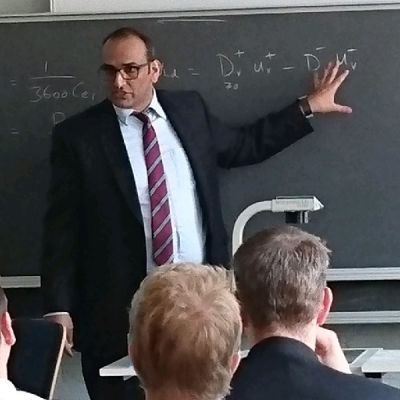
Faisal Altaf
Principal Research Engineer & Project Manager AE and Research—ESS Control & SWVolvo Group Trucks Technology

12:20 pm - 1:00 pm
How BMS could minimize the ‘weakest cell problem’
Dr. Jorge Varela Barreras -
Senior Researcher in Battery Modelling, Joint Chairman of the IEEE UK & Ireland Education Chapter,
Imperial College
• There are cell-to-cell differences in battery packs, in terms of capacity, resistance, or temperature
• This results in pack performance limited by the cells with the lowest remaining capacity
and available power, i.e. the weakest cells
• How to overcome the ‘weakest cell problem’
• What BMS could do: a new generation of active balancing systems

Dr. Jorge Varela Barreras
Senior Researcher in Battery Modelling, Joint Chairman of the IEEE UK & Ireland Education ChapterImperial College

1:00 pm - 2:00 pm
Networking Luncheon
2:00 pm - 2:40 pm
Effective Control of health and aging instead of balancing and monitoring the death of your battery
Hans Harjung -
CEO & Founder,
e-moove GmbH
• Why is the potential of the battery pack not the sum of the potential of all battery cells?
• What would an ideal BMS look like?
• How can we effectively control health and aging?
The presentation will tackle these questions and show a disruptive and highly cost-effective solution
to achieve a maximum lifetime, performance and safety of your battery.
Hans Harjung, CEO & Founder, e-moove GmbH


2:40 pm - 3:30 pm
Round table session | Requirements to future Battery Management systems
Dr. Jorge Varela Barreras -
Senior Researcher in Battery Modelling, Joint Chairman of the IEEE UK & Ireland Education Chapter,
Imperial College
Torsten Wik - Professor, Electrical engineering, Chalmers University of Technology
Chrysanthos Tzivanopoulos - Senior engineer of the Battery Management System Hardware Development for Lithium Ion Batteries, Robert Bosch Battery Systems GmbH
BMS is an integral part of a car since it protects the battery from damage, predicts battery life and maintains the battery in an operational condition. A discussion on the requirements is needed in order to understand what the current status of the technology and what is necessary to make sure that the future is carried out safely. We invite delegates to discuss and elaborate with experts. For each topic you chose, you have 20 minutes to discuss it in your group. The results will be presented at the end.
14:40 Session I • 15:05 Break for Switching • 15:15 Session II
Table A | Battery state estimation
• Factors to be aware
Dr. Jorge Varela Barreras, Senior battery researcher, Imperial College London
Table B | BMS algorithms
• How intelligent BMS algorithms can ensure lifetime and safety
Torsten Wik, Professor, Electrical engineering, Chalmers University
Table C | BMS architecture requirements future outlook
• Centralized (BCU&CSC as one unit) vs. decentralized BCU and CSC separated
• Com. Bus @ decentralized systems(CAN / Daisy Chain / Wireless)
• BMS partitioning (HV Part within BCU / HV part within together current sensing / BCU within BDU)
Chrysanthos Tzivanopoulos, Senior engineer of the Battery Management System Hardware
Development for Lithium Ion Batteries, Robert Bosch GmbH
Dr. Jorge Varela Barreras
Senior Researcher in Battery Modelling, Joint Chairman of the IEEE UK & Ireland Education ChapterImperial College



Chrysanthos Tzivanopoulos
Senior engineer of the Battery Management System Hardware Development for Lithium Ion BatteriesRobert Bosch Battery Systems GmbH

3:40 pm - 3:50 pm
Presentation of results to the audience
3:50 pm - 4:20 pm
Refreshment break and networking
4:20 pm - 5:00 pm
Light BMS design
Prashanth Vemireddy -
BMS Software developer,
LionSmart Gmbh
• Designing the “light BMS”
• Application to light battery
• How does the data communication work: infrared channels between battery modules